Tom Yum Soup (Authentic Thai Hot and Sour Soup)
Thailand's most famous soup — an intensely aromatic, boldly flavoured broth of lemongrass, galangal, kaffir lime leaves, and chilli, balanced with fish sauce and lime juice. Deeply satisfying and genuinely authentic.
What is this dish?
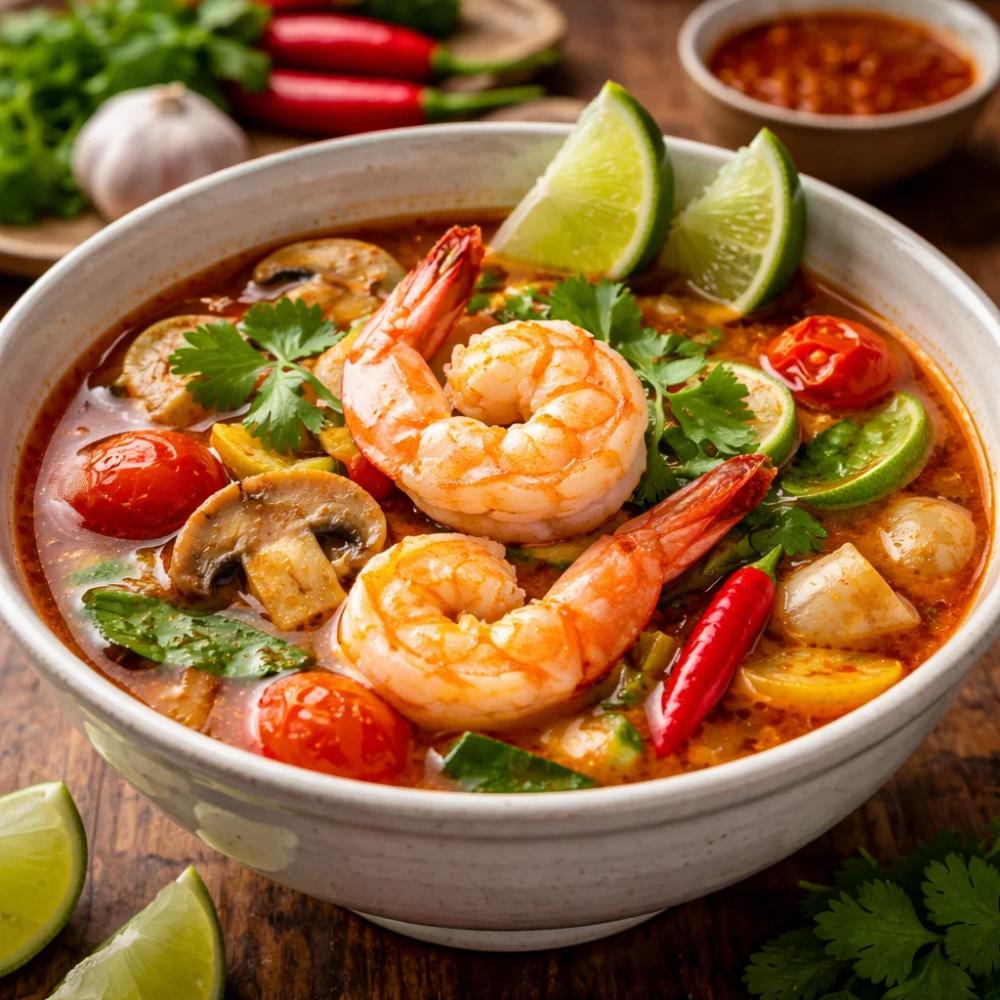
Tom yum (ต้มยำ) is Thailand's most internationally recognised dish — a fragrant, fiery, intensely sour hot soup built on a base of lemongrass, galangal, kaffir lime leaves, and bird's eye chilli. It exists in two main versions: tom yum goong (clear, with prawns) and tom yum nam khon (creamy, with coconut milk and roasted chilli paste). Both are defined by the same characteristic flavour balance: hot, sour, salty, and sweet.
Why you'll love it
Tom yum is one of the most flavour-efficient soups in existence — maximum aromatic impact for minimal cooking time. The combination of citrus, heat, funk, and sweetness creates a flavour profile unlike any other cuisine, and it is ready in 25 minutes. Low in calories, high in flavour, and genuinely warming.
When to serve
Tom yum works as a starter at a Thai dinner, a light main course with steamed rice, or a restorative soup when you need something warming and flavour-packed.
Quick tips
Bruise every aromatic firmly before adding to the pot. Infuse for at least 5 minutes before adding protein. Season off the heat with fish sauce and lime. Balance hot, sour, salty, and sweet to your palate.
Lemongrass
The aromatic signature of tom yum — provides a distinctive citrus-grass fragrance that cannot be replicated by any other ingredient. Use only the bottom 15cm (the pale, inner part) and bruise firmly.
Galangal
A relative of ginger with a sharper, more peppery, and less sweet flavour — the defining aromatic of South-East Asian cooking. Not interchangeable with ginger but ginger is an acceptable emergency substitute.
Kaffir Lime Leaves
The hourglass-shaped double leaves of the kaffir lime tree, with an intense, bright citrus fragrance entirely different from regular lime. Available fresh or frozen from Asian supermarkets.
Fish Sauce
The salt component that also provides a pungent, fermented umami depth. Added off the heat to preserve its complex character. The main seasoning of the soup alongside the lime juice.
Bird's Eye Chillies
Small, intensely hot Thai chillies that provide the heat component. Bruised rather than sliced to control infusion rate — the longer they cook, the hotter the broth becomes.
Substitution Options
Fresh ginger (1.5x the quantity) can substitute galangal in an emergency. Dried kaffir lime leaves are significantly less fragrant — use twice the quantity. Soy sauce can replace fish sauce for a vegetarian version. King prawns can be replaced by chicken, tofu, or mixed mushrooms. Nam prik pao is the crucial ingredient for the creamy version — find it at Asian supermarkets.
Step-by-Step Instructions
Infuse the aromatics
Pour the chicken stock or water into a medium saucepan and bring to a boil. Add the bruised lemongrass pieces, galangal slices, torn kaffir lime leaves, and bruised bird's eye chillies. Reduce to a steady simmer and cook for 5–7 minutes to infuse the broth with the aromatics. The broth will turn pale yellow and fragrant.
Pro Tips:
- •Bruising the lemongrass and chillies by pressing firmly with the flat of a knife releases their essential oils into the broth far more effectively than simply slicing.
- •Kaffir lime leaves torn rather than left whole expose more surface area and infuse more citrus fragrance.
Add mushrooms and protein
Add the mushrooms to the simmering broth and cook for 2 minutes. Add the prawns (or sliced chicken) and tomato wedges if using. Cook for 2–3 minutes until the prawns are pink and just cooked through, or the chicken is opaque. Do not overcook — prawns become rubbery in seconds beyond just-cooked.
Pro Tips:
- •Add the prawns last as they cook in under 3 minutes. Overcooked prawns ruin the delicacy of the soup.
- •If using chicken, slice it very thinly (3–4mm) against the grain so it cooks quickly and stays tender.
Season the broth
Remove from the heat. Season with 3 tablespoons fish sauce, 2 tablespoons lime juice, and 1 teaspoon sugar. Taste and adjust — the soup should be intensely sour, salty, hot, and aromatic, with a slight sweetness in the background. For the creamy version, stir in the nam prik pao paste and coconut milk before seasoning and return briefly to a simmer.
Pro Tips:
- •Tom yum is seasoned off the heat to preserve the fresh brightness of the lime juice — heat destroys its volatile citrus character.
- •The balance of fish sauce (salt), lime (sour), chilli (hot), and sugar (sweet) is the essence of Thai flavour. Adjust each element until the soup tastes intense and harmonious.
Serve
Ladle into bowls, ensuring each bowl gets prawns, mushrooms, and broth. Garnish with fresh coriander and sliced spring onion. Serve immediately with steamed jasmine rice on the side.
Pro Tips:
- •The lemongrass, galangal, lime leaves, and chillies in the soup are not meant to be eaten — push them to the side of the bowl as you eat.
- •Tom yum must be eaten immediately — the fresh aromatics deteriorate quickly once the heat is off.
Chef's Tips
Techniques that separate good from great
Bruise aromatics hard before adding to stock
Lemongrass, galangal, and lime leaves release their essential oils most efficiently when their cell walls are mechanically ruptured before cooking. Pressing the flat of a heavy knife firmly over each lemongrass stalk until it cracks, squeezing each lime leaf before tearing it, and crushing the chillies maximises the infusion. The difference in aromatic intensity between bruised and unbruised aromatics is significant.
Add fish sauce and lime off the heat
Both fish sauce and fresh lime juice contain volatile aromatic compounds that degrade quickly at cooking temperature. Fish sauce loses its complex fermented depth; lime juice loses its bright, floral citrus character and becomes simply acidic. Adding both off the heat after the protein is cooked preserves the full aromatic profile that defines authentic tom yum.
Use stock, not water, for the base
Tom yum is traditionally made with water or very light stock — the flavour comes almost entirely from the aromatics. However, using a good chicken stock as the base adds a body and savoury depth that makes the soup significantly more satisfying without obscuring the aromatics. If using water, add an extra stalk of lemongrass and an extra kaffir lime leaf.
Strain the aromatics before serving for a cleaner bowl
The lemongrass, galangal, and lime leaves are inedible and distracting in the final soup. For a restaurant-quality presentation, ladle the soup through a fine strainer into the bowls, then drop the prawns and mushrooms back in. The resulting bowl is clean, glossy broth with just the protein and vegetables — the defining appearance of a well-made tom yum.
Nutrition Facts
Equipment Needed
- Medium saucepan
- Knife and cutting board
- Ladle
- Citrus squeezer
Quick Tips
- Bruise the lemongrass and chillies firmly with the flat of a heavy knife or the back of a spoon — this ruptures the cell walls and releases the maximum amount of aromatic essential oils into the broth.
- Season with fish sauce and lime juice off the heat. Adding lime juice to a boiling broth volatilises its citrus compounds immediately, leaving only acidity without any of the fresh lime fragrance.
- Tom yum is defined by its balance of four Thai flavour profiles — hot (chilli), sour (lime), salty (fish sauce), and sweet (sugar). Taste and adjust each element independently until the balance feels right.
Recipe Variations
Different ways to make this dish your own
Tom Yum Goong (Classic Clear Prawn Version)
The standard recipe as written — clear, intensely flavoured broth with prawns. The most ordered Thai soup in the world.
Tom Yum Nam Khon (Creamy Version)
Add 2 tablespoons of nam prik pao and 100ml of coconut milk to the strained, seasoned broth. Return to a gentle simmer for 2 minutes. The richer, milder version favoured in central Thailand.
Tom Yum Gai (Chicken Version)
Replace prawns with 200g of thinly sliced chicken breast. Simmer for 4–5 minutes until just cooked through. The most commonly found version outside Thailand.
Vegetarian Tom Yum
Use vegetable stock, replace fish sauce with soy sauce plus a splash of lime, and use a mixture of oyster, enoki, and shiitake mushrooms as the protein.
What to Serve With
Perfect pairings to complete the meal
Steamed Jasmine Rice
The essential accompaniment — plain, fragrant jasmine rice absorbs the intensely flavoured broth and provides a starchy counterpoint to the hot and sour soup.
Pad Thai or Stir-Fried Vegetables
Tom yum works beautifully as a starter before a pad Thai or vegetable stir-fry main — together they create a complete Thai meal.
Thai Iced Tea (Cha Yen)
Sweet, creamy Thai iced tea provides a dairy-based cooling contrast to the hot and sour soup — a popular Thai restaurant pairing.
Extra Condiments at the Table
Provide extra sliced bird's eye chillies, fish sauce, lime wedges, and sugar — the traditional Thai condiment set that lets each diner adjust their own bowl.
Storage & Make-Ahead
Keep it fresh and plan ahead
Refrigerator
Store for up to 2 days. The aromatics will continue infusing, making the broth stronger — remove them after cooking if you prefer a more controlled flavour.
Freezer
The broth (strained, without prawns) freezes well for up to 2 months. Prawns become rubbery after freezing — add fresh prawns when reheating.
Make-Ahead
The aromatic broth can be made up to 2 days ahead. Reheat, add fresh prawns and mushrooms, season off the heat just before serving.
Reheating
Reheat the broth gently to just below simmering. Add the protein fresh — never reheat cooked prawns in the soup as they become very tough. Add fresh lime juice after reheating.
Be the first to review this recipe!
Got Leftovers?
Turn what you already have in your fridge into delicious meals. Our AI-powered generator creates personalized recipes from your ingredients.
Browse more like this:
You Might Also Like
Discover more delicious recipes similar to what you're cooking