Pho Bo (Vietnamese Beef Noodle Soup)
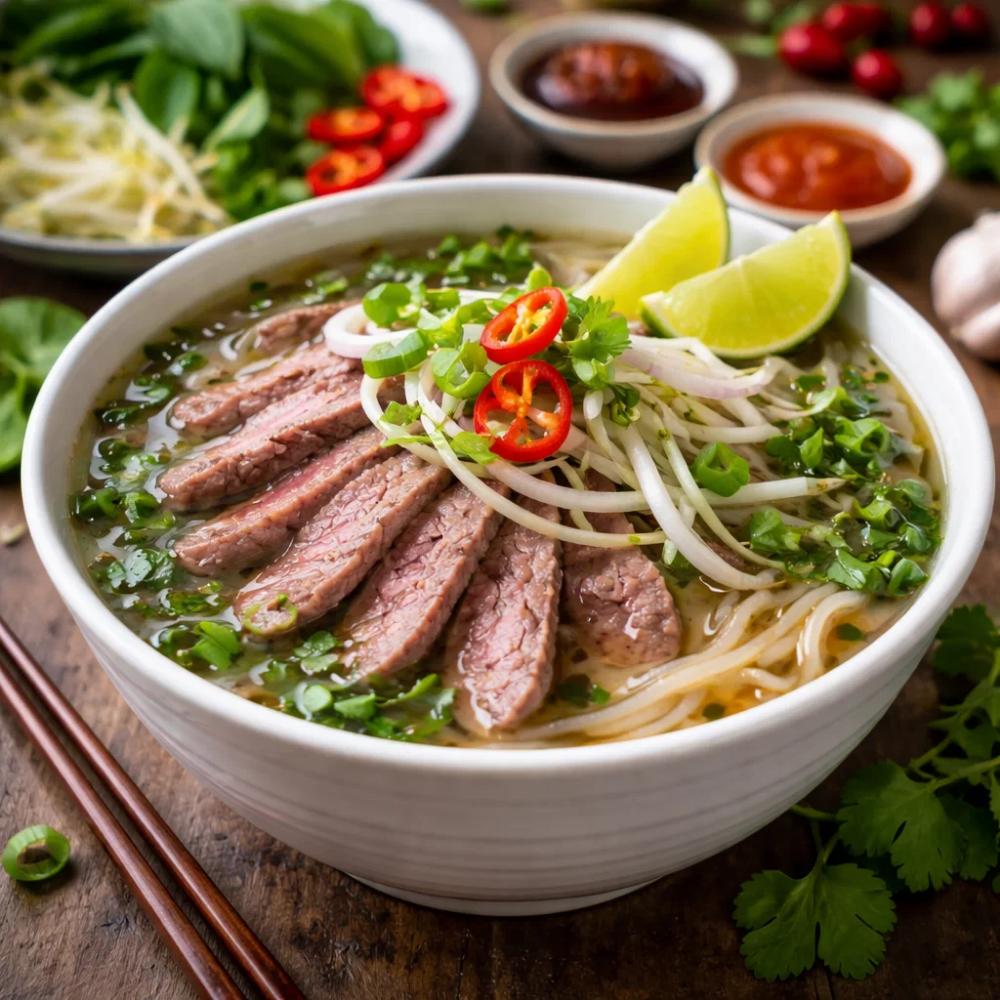
Vietnam's most celebrated dish: a deeply fragrant, star anise and cinnamon-scented beef broth served over rice noodles with thinly sliced raw beef that cooks in the piping hot soup. A bowl of extraordinary complexity.
What is this dish?
Pho bo (phở bò) is Vietnam's most iconic national dish — a deeply fragrant, clear beef broth infused with charred onion and ginger, star anise, cinnamon, and cloves, served over soft flat rice noodles with thinly sliced raw beef that cooks in the piping hot soup at the table. It originated in northern Vietnam in the early 20th century and has become one of the world's most beloved soups, appreciated for the extraordinary depth of its broth and the theatre of its assembly.
Why you'll love it
Pho is one of the most complex, rewarding soups in world cooking — the broth alone is a work of art that takes time but delivers a fragrant, golden, deeply savoury result that no other dish can replicate. Made at home, it is a project worth the effort, and the result is a bowl of extraordinary flavour and elegance.
When to serve
Pho is traditionally eaten as a breakfast dish in Vietnam but works beautifully as a weekend project dinner, a celebration meal, or a warming winter centerpiece. It is particularly suited to social eating — set the garnishes in the middle of the table and let everyone customise their bowl.
Quick tips
Char the onion and ginger until genuinely black. Blanch and rinse the bones before using. Keep the simmer as gentle as possible. Season the broth carefully with fish sauce and sugar before serving. Pour boiling broth over the raw beef.
Marrow Bones
The foundation of the broth — beef marrow and knuckle bones provide collagen, gelatin, and a deep savoury richness that gives pho broth its characteristic body. Blanching removes impurities for a clear broth.
Star Anise
The defining spice of pho — its anise, slightly liquorice flavour is the most immediately identifiable element of the broth's character. Toasted before use for maximum impact.
Charred Onion and Ginger
The characteristic technique unique to pho — directly charring these aromatics adds a subtle smokiness and caramelised sweetness to the broth that distinguishes authentic pho from other beef-based soups.
Fish Sauce
The sole seasoning agent — it provides salt and deep, fermented umami that beef stock alone cannot replicate. The final balance of fish sauce and sugar in the finished broth is the defining taste calibration of every pho cook.
Substitution Options
Beef chuck can replace brisket — it is slightly less gelatinous but equally flavourful. Fresh beef stock of good quality can replace homemade bone broth as a shortcut — simmer with the aromatics and spices for 30 minutes. Rice noodles of any width work — wider noodles are more traditional in the north, thinner in the south. Soy sauce can replace fish sauce for a vegetarian version, though the flavour is noticeably different.
Step-by-Step Instructions
Char the onion and ginger
Place the halved onion and ginger cut-side down directly on a gas hob flame or under a very hot grill. Char for 5–7 minutes until deeply blackened on the surface — not just browned, genuinely charred. This is not a mistake. Rinse briefly under cold water and scrape off the most charred exterior, leaving a smoky, caramelised surface. Set aside.
Pro Tips:
- •The charring is essential to authentic pho — it adds a subtle smokiness and deep caramelised sweetness to the broth that cannot be replicated any other way.
- •Char on a gas hob directly on the flame in tongs, or place on foil under the grill at maximum heat.
Blanch the bones
Place the marrow bones in a large pot and cover with cold water. Bring to a rolling boil and boil hard for 5 minutes. Drain the bones and rinse them thoroughly under cold water, scrubbing off any grey scum. Clean the pot. This blanching step removes the impurities that would make the broth cloudy and unpleasant-tasting.
Pro Tips:
- •Blanching bones is a critical step for a clear, clean-tasting pho broth. Skipping it produces a murky, slightly unpleasant broth.
- •Rinse the bones under cold running water and scrub with a brush for the best results.
Toast the spices
In a dry frying pan over medium heat, toast the star anise, cinnamon stick, cloves, coriander seeds, and peppercorns together for 2–3 minutes, stirring, until they are fragrant and slightly darkened. Remove immediately — they burn quickly once fragrant. The toasting intensifies their aromatic oils.
Pro Tips:
- •Toast just until fragrant — 2–3 minutes. Over-toasted spices become bitter.
- •Use a dry pan — no oil. The dry heat causes the spice oils to volatilise differently from oil-cooked spices.
Simmer the broth
Return the blanched bones to the cleaned pot. Add the brisket, charred onion and ginger, toasted spices, fish sauce, sugar, salt, and 2 litres of water. Bring to a boil, then reduce to the gentlest possible simmer — just barely bubbling. Cook for 90 minutes (minimum), skimming any fat or foam from the surface every 20 minutes. The brisket should be tender after 75–90 minutes — remove it then, slice, and set aside. The bones continue in the broth.
Pro Tips:
- •A gentle simmer is critical for a clear broth — vigorous boiling emulsifies fat and protein into the broth, making it cloudy.
- •The brisket typically becomes tender and sliceable at 75–90 minutes. Remove and slice it when done — it does not need to simmer for the full broth time.
Strain the broth and cook noodles
Strain the finished broth through a fine-mesh sieve into a clean pot. Discard the bones and spent aromatics. Taste the broth and adjust seasoning with fish sauce, sugar, and salt. It should taste intensely savoury, faintly sweet, warmly spiced with star anise, and clean. Soak the rice noodles in cold water for 30 minutes, then cook in boiling water for 3–5 minutes until just tender. Drain.
Pro Tips:
- •A good pho broth should be almost clear, with a rich amber colour. If cloudy, it was boiled too vigorously.
- •Always taste the broth and season before serving — the balance of fish sauce (salty/umami) and sugar (sweetness) is the final calibration.
Assemble the bowls
Reheat the broth to a rolling boil. Divide the cooked noodles between deep bowls. Top with thin slices of the cooked brisket and the very thinly sliced raw sirloin. Ladle the boiling broth over the top immediately and with height — the hot broth cooks the raw beef slices in the bowl. Garnish with sliced spring onion. Serve with a plate of beansprouts, Thai basil, coriander, sliced chillies, and lime wedges on the side.
Pro Tips:
- •The broth must be at a rolling boil when poured over the raw beef — this is what cooks the beef in the bowl. Warm broth will not cook it sufficiently.
- •Slice the raw beef as thinly as possible — freeze for 15 minutes before slicing for easier thin cuts.
Chef's Tips
Techniques that separate good from great
Char the onion and ginger until genuinely black
Many Western recipes shy away from properly charring the onion and ginger for pho, producing only a light browning. Authentic pho requires the onion and ginger to be genuinely charred on the surface — creating pyrazines and Maillard compounds that add a subtle, complex smokiness to the broth. After charring, scrape off the most charred exterior and use the caramelised flesh. This single step is the most identifiable flavour difference between authentic and inauthentic pho broth.
Blanch bones in boiling water and rinse before using
Raw marrow bones contain myoglobin, proteins, and impurities in the marrow cavities that cloud a broth if not removed first. Boiling the bones hard for 5 minutes forces these impurities out, after which rinsing and scrubbing the bones removes them entirely. The subsequent long-simmered broth is a completely different product — clear, golden, and clean-tasting rather than murky and slightly gamey.
Keep the simmer as gentle as possible throughout
The clarity of pho broth is achieved through a very gentle simmer — barely moving, with small bubbles rising slowly from the base. At this temperature, the fat rises to the surface where it can be skimmed, rather than being agitated into emulsion. A rolling boil suspends fat and protein fragments throughout the liquid permanently, producing a murky result that cannot be clarified.
Pour boiling broth from a height over raw beef
The raw sirloin placed in the bowl is designed to be cooked by the boiling broth poured over it — not by subsequent simmering. The broth must be at a full rolling boil when poured, and it should be poured from a height to ensure it remains as hot as possible when it contacts the beef. Paper-thin beef slices at 2–3mm cook to perfect medium-rare in the broth within 30–60 seconds.
Nutrition Facts
Equipment Needed
- Large stockpot (at least 6-litre)
- Fine-mesh sieve or chinois
- Tongs
- Ladle
- Knife and cutting board
- Dry frying pan (for spice toasting)
- Deep serving bowls (as large as possible)
Quick Tips
- The blanching step for bones is not optional — it removes impurities that cause a cloudy, unpleasant broth. This 10 minutes of prep determines whether the broth is clear and clean or murky.
- Always simmer the broth gently — a gentle simmer produces a clear, golden broth. A vigorous boil emulsifies fat and protein fragments into the liquid, creating cloudiness.
- Freeze the raw sirloin for 15 minutes before slicing — the partial freezing firms the meat and makes it far easier to slice at the 2–3mm thinness required for in-bowl cooking.
Recipe Variations
Different ways to make this dish your own
Pho Ga (Chicken Pho)
Replace beef bones and brisket with a whole chicken simmered in the water for 60 minutes. Use the same spices and charred aromatics. The resulting broth is lighter, more delicate, and the shredded chicken replaces the beef toppings.
Pho with Tendon and Tripe (Pho Dac Biet)
Add sliced beef tendon (thinly sliced from pre-cooked tendon simmered 3 hours until gelatinous) and blanched beef tripe as additional toppings alongside the brisket and raw beef. The special combination bowl found in Vietnamese restaurants.
Vegetarian Pho
Substitute the beef bones with 2 large portobello mushrooms, 1 head of roasted garlic, and 2 tablespoons of soy sauce added to 2 litres of good vegetable stock. Simmer with the same toasted spices and charred aromatics for 45 minutes. Top with tofu, mushrooms, and the same fresh herb garnishes.
Pho Bo Kho (Spicy Braised Beef Pho)
Braise 500g of beef chuck in the pho broth with lemongrass, chilli, and star anise until fork-tender and falling apart. The braised beef is served in the soup instead of thinly sliced raw beef — a more substantial, spicy southern variation.
What to Serve With
Perfect pairings to complete the meal
Fresh Herb Platter at the Table
A large plate of Thai basil, fresh coriander, beansprouts, sliced chillies, and lime wedges is served alongside every bowl — add to your taste as you eat, not all at once.
Hoisin Sauce and Sriracha
The traditional condiments provided alongside pho — hoisin is squeezed in and stirred into the broth for sweetness and depth; sriracha adds heat. Use separately or in combination.
Steamed Jasmine Rice
Not traditional but a common addition for those wanting a more substantial meal — a small bowl of rice alongside absorbs the extra broth from the bowl.
Vietnamese Iced Coffee (Cà Phê Sữa Đá)
The classic Vietnamese pairing with pho — very strong drip coffee with sweetened condensed milk over ice provides a sweet, creamy counterpoint to the savoury soup.
Storage & Make-Ahead
Keep it fresh and plan ahead
Refrigerator
Store the broth separately from the cooked noodles and brisket for up to 4 days. The fat solidifies on the surface — skim it off for a clean broth or stir it back in for richness. The broth improves with time.
Freezer
The broth freezes excellently for up to 4 months — portion into containers for convenient future meals. Freeze without noodles. Thaw overnight and reheat to a rolling boil before serving.
Make-Ahead
The broth is ideal for making 2–3 days ahead and refrigerating — the flavour develops significantly. Cook noodles and prepare garnishes fresh when serving.
Reheating
Reheat the broth to a rolling boil before serving — it must be very hot to cook the raw beef slices in the bowl. Never serve pho with warm or hot-but-not-boiling broth as it will not cook the beef adequately.
Be the first to review this recipe!
Got Leftovers?
Turn what you already have in your fridge into delicious meals. Our AI-powered generator creates personalized recipes from your ingredients.
Browse more like this:
You Might Also Like
Discover more delicious recipes similar to what you're cooking