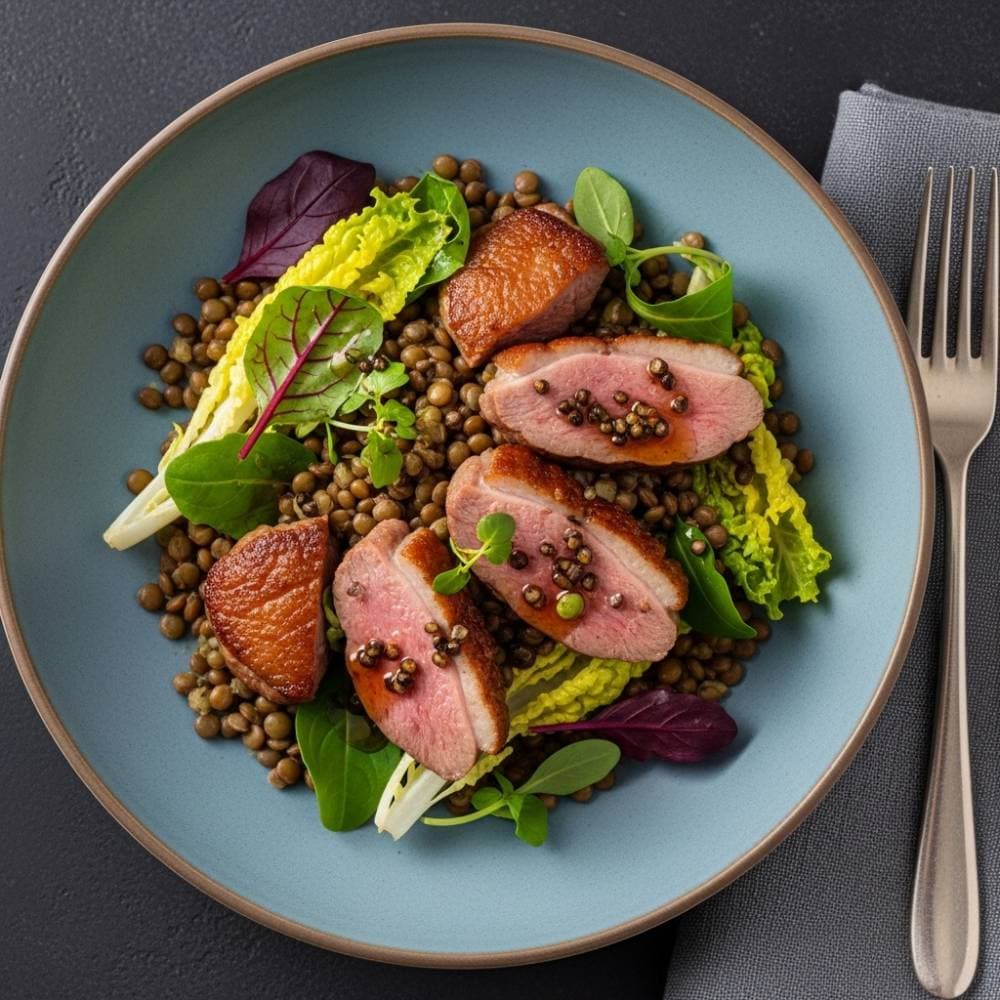
Lentil and Duck Salad with Dijon Vinaigrette
A sophisticated and hearty salad featuring tender cooked lentils, crispy seared duck breast, and crisp vegetables, all tossed in a bright and tangy Dijon vinaigrette. A flavorful meal for two.
About This Recipe
What is this dish?
This lentil and duck salad is a French bistro classic — combining earthy, firm Puy lentils with crispy-skinned, medium-rare duck breast and crisp vegetables, all dressed in a mustard-forward Dijon vinaigrette. The dish exemplifies the French ability to combine humble ingredients (lentils) with luxurious ones (duck) into something that transcends both in a way that feels quintessentially bistro.
Why you'll love it
This salad is simultaneously elegant and deeply satisfying — the rich, crispy duck skin and pink, tender meat against the earthy Dijon-dressed lentils creates a balance of luxury and rusticity that feels quintessentially French. It's naturally gluten-free and dairy-free, substantial enough to be a complete meal, and the vinaigrette ties every element together beautifully.
When to serve
This salad works year-round as a sophisticated lunch or a light dinner. It's ideal for dinner parties where you want something impressive but not overly rich. Serve it warm (freshly cooked lentils and hot duck) for the most spectacular presentation, or at room temperature for easier entertaining.
Quick tips
Render the duck fat slowly starting in a cold pan — patience here produces the crispiest skin. Rest the duck for 5 minutes before slicing to keep it juicy. Dress warm lentils immediately so they absorb the vinaigrette's flavor. Use Puy lentils specifically — they hold their shape where others turn mushy.
Ingredient Highlights
Duck Breast
The luxury element. Skin-on duck breast scored in a crosshatch pattern and started in a cold pan allows the fat to render slowly, producing spectacular crispy skin with juicy, flavorful meat beneath. Duck breast is best served medium-rare — 135-140°F internal temperature.
Puy Lentils (French Green Lentils)
Small, dark green lentils from the Auvergne region of France with a peppery flavor and superior ability to hold their shape after cooking. They are the only lentil suitable for salads — they remain distinct and toothsome rather than falling apart into mush.
Dijon Mustard
The essential emulsifier and flavor in the vinaigrette. True Dijon mustard (made with white wine and Burgundy vinegar) is sharp, complex, and has a heat that regular yellow mustard completely lacks. It binds oil and vinegar into a stable, pungent dressing that clings to the lentils.
Red Wine Vinegar
The acid that brightens and balances the richness of the duck fat and lentils. Whisked with Dijon, shallots, and olive oil, it creates a classic French bistro vinaigrette. Dressing warm lentils allows them to absorb the vinaigrette and become fully flavored throughout.
Substitution Options
Replace duck breast with chicken thighs (cook fully to 165°F), smoked duck, seared salmon fillet, or sliced grilled steak. Puy lentils can be replaced with beluga black lentils (also hold their shape well). For a vegetarian version, use roasted beets, crispy chickpeas, or pan-fried halloumi as the protein. Sherry vinegar or champagne vinegar can substitute for red wine vinegar for a slightly different acid note. Whole grain mustard can replace Dijon for a more textural dressing. Walnuts or hazelnuts can be added for crunch.
Step-by-Step Instructions
Cook the lentils
Rinse 1/2 cup green or Puy lentils thoroughly. In a small pot, combine the rinsed lentils with 2 cups chicken broth or vegetable broth, 1 bay leaf, and 1/4 teaspoon salt. Bring to a boil, then reduce heat to low, cover, and simmer (cook gently just below boiling, with small bubbles) for 20-25 minutes, or until the lentils are tender but still hold their shape. Remove the bay leaf. Drain any excess liquid and set the lentils aside to cool slightly. Puy lentils are small, dark green lentils that hold their shape well after cooking.
Chef's Tips
- ›Simmer means to cook gently just below boiling, with small bubbles.
- ›Do not overcook the lentils, or they will become mushy.
Prepare the duck breast
Score the skin of the 1 duck breast in a crosshatch pattern (cut shallow lines across it without cutting into the meat). Season both sides of the duck breast with 1/4 teaspoon salt and 1/8 teaspoon black pepper. Place the duck breast, skin-side down, in a cold skillet. Turn the heat to medium-low and slowly render (melt out) the fat from the skin for 8-12 minutes, or until the skin is crispy and golden brown. Pour off excess fat periodically. Once crispy, flip the duck breast and cook on the meat side for 3-5 minutes, depending on your desired doneness (medium-rare to medium). The internal temperature should reach 135-140°F (57-60°C). Remove the duck from the skillet and let it rest for 5 minutes before slicing.
Chef's Tips
- ›Rendering fat slowly makes the skin extra crispy.
- ›Resting the duck after cooking keeps it juicy and tender.
Make the Dijon vinaigrette
While the duck rests and lentils cool, make the vinaigrette. In a small bowl, whisk together 2 tablespoons red wine vinegar, 1 tablespoon Dijon mustard, 1/4 teaspoon minced shallot or finely minced onion, 1/4 teaspoon salt, and 1/8 teaspoon black pepper. Slowly drizzle in 3 tablespoons olive oil while whisking constantly until the dressing is emulsified (smooth and well-mixed).
Chef's Tips
- ›Whisking constantly helps the oil and vinegar mix smoothly.
- ›Emulsified means smooth and well-mixed, like mayonnaise.
Assemble and serve
In a medium bowl, combine the cooled lentils, finely diced 1/2 medium carrot, finely diced 1 stalk celery, and finely diced 1/4 small red onion. Pour the Dijon vinaigrette over the lentil mixture and toss gently to coat. Slice the rested duck breast thinly. Divide the lentil salad between two plates. Top each serving with the sliced duck breast. Garnish with 2 tablespoons chopped fresh parsley or chives. Serve immediately.
Chef's Tips
- ›Assembling the salad just before serving keeps the vegetables crisp.
- ›A sharp knife helps slice the duck cleanly.
Chef's Tips
Techniques that separate good from great
Start the duck in a cold pan — this is how you achieve the crispiest skin
Placing duck breast skin-side down in a cold pan and slowly raising the heat allows the thick fat layer under the skin to render gradually, frying the skin in its own fat for maximum crispiness. If you start in a hot pan, the outside skin browns quickly but the fat doesn't render, resulting in a chewy, fatty layer under a thin browned exterior. Cold pan, medium-low heat, patience.
Rest the duck for a full 5 minutes after cooking before slicing
During cooking, the muscle fibers contract and push moisture toward the center of the breast. Resting allows the fibers to relax and the moisture to redistribute evenly throughout. Slice immediately and the juices run out onto the cutting board. Rest for 5 minutes and the duck stays pink and juicy all the way through.
Dress warm lentils while they're still hot from cooking
Hot lentils are porous and actively absorb flavors. Dress them with the Dijon vinaigrette within 2-3 minutes of draining while they're still steaming. As they cool, they contract and become less receptive to absorbing the dressing. Lentils dressed hot will taste fully seasoned and rich; lentils dressed cold taste underdressed.
Cook Puy lentils to just-tender — they should resist slightly when bitten
The difference between perfectly cooked and overcooked Puy lentils is about 3-4 minutes of cooking time. Check them frequently starting at 20 minutes. They should be completely tender but still hold their shape with a slight bite. Mushy, fallen-apart lentils cannot be recovered and make a poor salad.
Nutrition Facts
Per serving · Estimated values
* Estimated per serving based on a 2,000 calorie diet.
Equipment Needed
- Small pot (for lentils)
- Medium skillet (for duck)
- Small bowl (for vinaigrette)
- Medium bowl (for salad assembly)
- Whisk
- Knife and cutting board
- Measuring cups
- Measuring spoons
Quick Tips
- For a vegetarian version, omit the duck and add roasted vegetables like butternut squash or sweet potato for extra heartiness.
- You can make the lentils and vinaigrette ahead of time and store them separately in the refrigerator. Assemble the salad just before serving.
- The choice of lentils matters; green or Puy lentils hold their shape best in salads.
Recipe Variations
Different ways to make this dish your own
Warm Lentil Salad with Seared Salmon
Replace duck with a skin-on salmon fillet seared skin-side down for crispy skin, then served over the lentil and vinaigrette base for a lighter, omega-rich variation that's equally elegant.
Lentil Salad with Crispy Lardons and Soft-Boiled Egg
Add pan-fried lardons (thick-cut bacon pieces) and a halved soft-boiled egg to the lentil salad for a more casual, heartier French bistro version. The runny yolk enriches the vinaigrette.
Persian-Spiced Lentil Salad
Season the lentils with cumin, coriander, and turmeric while cooking, then dress with a lemon-tahini vinaigrette. Top with pomegranate seeds, fresh herbs, and sliced red onion for a Middle Eastern flavor profile.
Beluga Lentil Salad with Roasted Beets and Goat Cheese
Use beluga (black) lentils with roasted beets, crumbled goat cheese, walnuts, and a balsamic-shallot vinaigrette for a beautiful, fully vegetarian variation with stunning color contrast.
What to Serve With
Perfect pairings to complete the meal
As a Sophisticated French Bistro Dinner for Two
Plate the Dijon-dressed lentils in the center of two plates, fan the pink-centered duck slices over the top, and garnish with chopped fresh parsley or chives. A wedge of baguette alongside is ideal for soaking up any vinaigrette pooled on the plate. Serve with a glass of Pinot Noir.
Served Warm for Maximum Flavor and Drama
The warm version — hot lentils dressed with vinaigrette, topped with freshly seared duck straight from the skillet — is the most spectacular presentation. The contrast of warm components against the acidic vinaigrette is extraordinary. Time the duck and lentils to finish simultaneously.
As a Make-Ahead Lunch for Two
The lentil base (dressed with vinaigrette) stores well in the refrigerator for 2-3 days. Cook fresh duck to order and slice over the chilled lentils for a restaurant-quality packed lunch that's ready in 15 minutes.
Paired with a Simple Baguette and Glass of Red Burgundy
A good baguette and a glass of Pinot Noir or red Burgundy turn this salad into a complete, refined meal. The wine's earthiness and cherry fruit notes complement both the duck and the lentils in a classically French combination.
Storage & Reheating
Keep it fresh and plan ahead
Refrigerator
Store components separately: dressed lentils for up to 3 days, sliced duck breast for up to 2 days. Assembled salad is best eaten the same day the duck is cooked for optimal texture.
Freezer
Cooked lentils freeze well for up to 3 months. Duck breast can be frozen for up to 2 months. Thaw overnight in the refrigerator. The vinaigrette does not need freezing — make fresh.
Make-Ahead
The lentils can be cooked and dressed with vinaigrette up to 2 days ahead. The vinaigrette keeps for up to a week refrigerated. Duck is best cooked fresh just before serving for crispy skin and proper doneness.
Reheating
Reheat lentils gently in a pan with a tablespoon of broth over medium heat. For the duck, reheat skin-side down in a dry skillet over medium heat for 2-3 minutes to restore crispiness, then briefly on the flesh side. Avoid microwaving duck as it turns gray and loses its texture.
Got Leftovers?
Turn what you already have in your fridge into delicious meals. Our AI-powered generator creates personalized recipes from your ingredients.
Go Deeper
Master the Culinary Science
Every recipe is a doorway. Our 7 Mastery Guides give you the science, technique, and framework to understand why food works — not just how to follow steps.
AI-Powered
Have Ingredients? Generate a Recipe.
Tell our AI what's in your fridge and get a custom recipe with image in seconds. No waste, no boredom.
Try the AI Recipe Generator →Browse more like this: